Developer Marketing: What Actually Works (And What I've Learned)

Cecilia Tao
April 28, 2026
Developers hate being marketed to. They've seen enough overpromised products and vague “industry-leading” claims to tune out anything that sounds like a pitch. But here's the thing: developer marketing isn't fundamentally different from good marketing. The bar is just higher, and the feedback loop is more public.
A great product is the foundation of word of mouth and sustainable growth. Content and the right channels can get developers to your door, but what keeps them there, and what makes them tell others is the product itself.
Here's what I've seen work, and what I've learned along the way.
Start Here: Great Product, No-Fluff Messaging, Great Docs
No channel strategy will save a weak product. Developers need to hit that “aha moment”, the point where your product clicks and they realize it genuinely solves something they care about.
Before you run a single ad:
Make it effortless to test. Frictionless API key generation so developers can sign up and get a key instantly. A curl command they can copy and run immediately. Code samples on landing pages. An in-browser playground or sandbox so they can test without any local setup. A free tier with no credit card required. SDKs that just work. Deep links that take developers directly to the product feature they care about, so they're not navigating around trying to find it. If a developer can't experience your product's value before talking to sales, you've already lost them.
Get your documentation right, and make it findable. Great docs are non-negotiable, but many companies invest in documentation and then let it become an SEO blind spot. A few common issues: docs sites often run on separate platforms (Readme, GitBook, and Mintlify) and quietly accumulate SEO problems, duplicate meta descriptions across similar pages, broken links without 301 redirects when pages are moved or renamed, and orphaned pages that aren't linked from navigation so search engines never find them. The subdomain vs. subfolder question matters too: docs.company.com splits domain authority away from your main site, while company.com/docs concentrates it. Treat your docs like a product, give them the same SEO attention you give your marketing site, and audit them regularly.
Communicate in a way developers trust. Skip the vague claims. Lead with what your product actually does. Instead of “blazing fast,” show the benchmark. Instead of “easy to integrate,” show the code snippet. Instead of “cost-efficient,” show what it actually costs. Developers evaluate based on specifics.
Leverage AI to Know Your Audience
Before you spend money on any channel, invest time understanding how your users actually think. AI has made this significantly faster.
Use AI for developer audience research. Tools like Claude's Research mode and Gemini's Deep Research can synthesize conversations across Reddit, developer forums, and community spaces at a scale no manual researcher can match. A few prompts worth trying:
- “What are the top questions developers ask when evaluating [tool type]? What signals do they look for?”
- “Summarize the most common complaints developers have about [category/competitor] based on Reddit and forum discussions.”
- “What tutorials or guides are developers in [space] asking for but struggling to find?”
- “Which communities, newsletters, or influencers do developers trust for tool recommendations?”
- “What use cases are developers most commonly building with [technology/category]?”
Deep research tools surface the qualitative picture: what developers care about, what frustrates them, what questions they're asking. Pair that with a keyword tool (SEMrush, Ahrefs) for the quantitative check: does this topic actually have search volume behind it, or is it just a niche conversation? Keyword search volume indicates real, broad interest in a topic. Also observe your own Discord or community spaces, that's where you see your actual users in real time and collect direct customer feedback.
Great Content is How You Earn Developer Trust
Here's the mental model I use: ads are a distribution channel to amplify great content and get your product in front of developers who'd actually benefit from it, not to directly sell them something. If your ads feel like a sales pitch, you'll struggle. If they're giving developers something useful, a guide, a workshop, a solution to a problem they're already searching for, you'll see great results from your campaign investment.
What content actually resonates with developers:
Original research and benchmarks: original research, performance comparisons, framework evaluations. If you publish data developers can't get elsewhere, they'll reference it, link to it, and share it. One of the best long-term plays for technical authority.
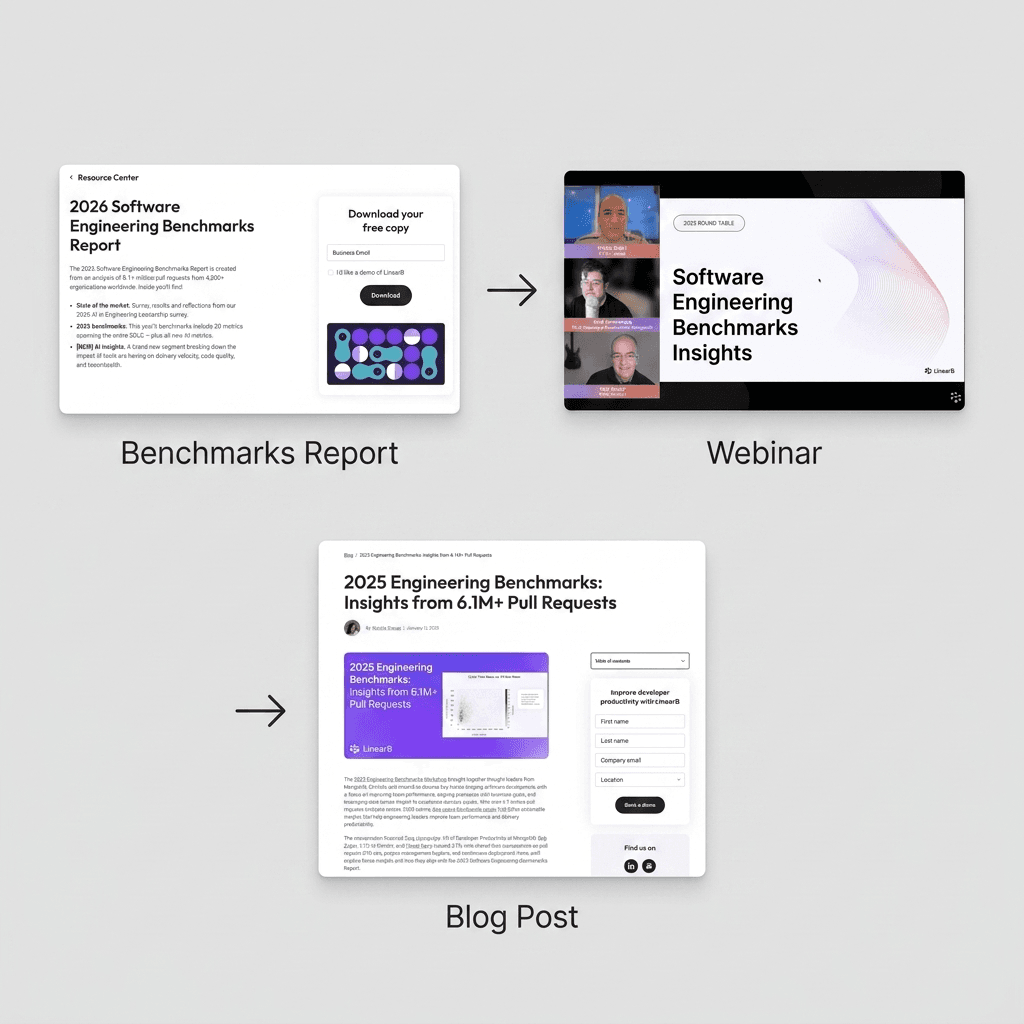
When I worked at LinearB, we published an annual software engineering benchmarks report built on real pull request data. Engineering leaders shared it widely because it gave them external benchmarks to measure and improve team efficiency, data they couldn't get elsewhere. The report was gated for lead generation, but we didn't stop there. We turned it into a webinar to walk through the insights, then leveraged an AI workflow that turned the webinar transcript and the report into a blog post targeting high search volume keywords, capturing SEO value the gated report couldn't. We cut the webinar into short video snippets for social sharing, and uploaded the full recording to YouTube with keyword optimization to improve our video search visibility.
Practical guides and tutorials: technically accurate, step-by-step, no filler. If it saves time or solves a real problem, developers will share it.
Webinars and workshops: these work well when the content is genuinely educational. The best ones naturally attract developers, and demonstrate your product's value through the content itself rather than through a pitch at the end. The ratio of learning to selling matters.
Case studies: particularly valuable for building credibility with engineering leaders, who are often the key buyer in larger deals. The case studies that work best don't read like marketing, they read like engineering retrospectives. Concrete problem, concrete solution, concrete results.
For high-effort, high-reward plays: Substack and podcasts can build real community and differentiation. But they require someone who deeply understands both the developer persona and the product space. Useful benchmarks, framework evaluations, honest product comparisons, content that educates and inspires, not content that promotes. At LinearB, we ran our own podcast, Dev Interrupted, alongside a Substack. The podcast content became a source of marketing assets we repurposed across channels.
How to Leverage the Right Channels to Reach Developers
Paid Search (Google + Bing)
Paid search is my top pick for PLG motions. Developers actively searching for solutions are the highest-intent traffic you can get. Target the right keywords and lead them directly to your product or a high-value resource.
Bing runs on the same keywords as Google but typically at lower CPCs, worth testing alongside Google. The critical watch-out: Microsoft automatically opts all advertisers into the Microsoft Audience Network, which extends your ads across MSN, Outlook.com, Microsoft Edge new tab, and a range of partner publisher sites. Placement quality on this network is inconsistent, and it's a common source of wasted spend. Audit your publisher placement reports regularly, exclude low-quality domains, and watch for click spikes that don't convert. Click fraud on extended networks is a real issue. Don't assume the defaults are optimized for you.
Reddit Ads
My top choice for paid social when targeting developers. Reddit's subreddit and keyword targeting lets you reach developers in the exact conversations they're already having about the problems your product solves.
Reddit ad copy needs to feel native to the platform. Lead with the problem, not the product. Back it up with something concrete: a benchmark, a real use case, a specific result. Skip the buzzwords.
Test different messaging and creatives across feed vs. conversation placements, and subreddits vs. keyword targeting. The performance difference can be significant. Watch out for automated targeting: pull placement reports regularly to monitor CPA, and turn it off if the cost per acquisition is inefficient. Don't assume Reddit's defaults are working in your favor.
At Inworld AI, one of our best-performing Reddit ads was a benchmark creative that didn't look like an ad at all. Through keyword targeting, it surfaced in conversations where users were actively comparing competitors or looking for alternatives, exactly the moment they were open to discovering something new. The result: a CTR 5x the Reddit benchmark.
LinkedIn is the right channel when you're targeting engineering leaders and technical buyers for brand awareness, lead generation, and ABM. The trade-off is cost, LinkedIn CPCs are the highest of any major ad platform, and for narrowly targeted technical audiences they can climb significantly. You need strong content and a clear funnel goal to make the economics work.
Three campaign formats worth knowing:
Document Ads + Lead Gen Forms are the strongest combination for lead generation. The document preview builds trust and lets developers assess the value before committing. The auto-filled Lead Gen Form removes friction and keeps users in the feed without sending them to a landing page. I ran a developer guide as a document ad and generated high-quality leads at under $50 per lead. One trade-off to know: this format drives leads, not website traffic. If your goal is product signups or landing page visits, you need a different approach.
Thought Leadership Ads promote posts from individual employee profiles rather than brand pages, and they consistently outperform brand content with engineering leaders. Founder posts in particular tend to drive the highest engagement and credibility. Use these to build brand awareness, establish credibility with engineering leaders, and retarget audiences who've already engaged with your content.
Conversation Ads let users choose their own path through multiple CTAs in a single message, download a guide, book a demo, talk to the team. Useful for driving direct sales leads and enterprise pipeline, especially when combined with ABM targeting.
For sales-assisted funnels, LinkedIn is the go-to for ABM if you have a target account list and contact list. Layer job function and seniority filters over your account list rather than relying on exact job titles. This captures more of the buying committee and reduces audience gaps.
I find connecting your CRM with LinkedIn's Revenue Attribution Report is very helpful to track how campaigns contribute to pipeline and revenue, not just leads. One important nuance: LinkedIn's default attribution counts impressions, not engagement. Make sure you're evaluating based on engagement. The difference in what LinkedIn claims to have “influenced” can be significant.
A few LinkedIn campaign settings to watch: disable audience expansion, it broadens your targeting beyond the audience you've defined and rarely improves results for technical audiences. The same goes for the LinkedIn Audience Network. Consider removing it entirely or running it as a separate campaign to test independently.
Also separate your campaigns by geography: NA, EMEA, and APAC. Traffic in the US is more expensive than other regions, and bundling geos in a single campaign creates budget control problems. Separate geo campaigns give you full control over budget and bidding strategy for each market, and let you optimize each region independently based on its own performance.
Video ads work well for top-of-funnel awareness. Once you've built an engaged audience, retargeting is where LinkedIn's efficiency improves significantly. Retarget users who've engaged with your top-of-funnel ads, watched your videos, or visited your website. Case study promotion works well as a mid-funnel play, particularly effective when retargeting engaged audiences or targeting engineering leaders in ABM campaigns.
Meta / Instagram
Meta tends to generate strong cost per lead, often better CPL than other paid social platforms. For reaching developers on Meta, job title targeting is worth testing. Interest-based targeting is also available: programming languages, developer tools like GitHub, VS Code, or Docker, and tech communities. Another approach worth considering: use tools that help you build a custom contact list of target developers and sync that data directly to Meta as a custom audience. Lookalike audiences built from your existing developer customers or email list round out the targeting options.
Conversion data is critical for Meta campaign optimization. Make sure you're sending conversion signals back to Meta via the Meta Pixel and Conversions API, the more signal Meta has on what a quality conversion looks like, the better it can optimize toward the right users.
Influencer Tutorial Videos
Working with a technically credible influencer in your category can drive real results. The primary outcome is brand awareness and credibility, not direct conversion, but a great tutorial video has a long tail of views, shares, and improved brand awareness. One signal worth tracking: brand search lift after an influencer campaign. If more developers are searching for your product by name after a campaign, that's a meaningful signal even when it's hard to attribute directly.
Email Newsletter
Good for content distribution and brand awareness. Where it underperforms: driving signups and actual product usage. Most newsletter opens happen on mobile, and it's hard to get a developer to start a trial or make an API call from their phone. Using newsletters to promote guides, workshops, and benchmarks, content that has value independent of the product, still works well.
Word of Mouth
No paid channel I've run beats a customer who genuinely loves your product talking about it publicly. This is worth treating as a channel you actively cultivate, not just something that happens organically.
Build case studies that customers are proud to be featured in, then encourage users to share their experiences on LinkedIn, Reddit, and X. Engineering leaders with strong networks are especially valuable, their posts reach other engineering leaders, and peer-to-peer credibility doesn't have an ad equivalent. The case study creation process itself can be accelerated with AI. An AI workflow that ingests customer call notes and meeting transcripts can dramatically reduce production time.
What Hasn't Worked for Me
These channels haven't worked for me, that doesn't mean they won't work for you, but with a limited budget I'd exhaust higher-signal options first.
Stack Overflow: used to be a top-tier developer channel. The platform has been declining and I haven't seen ad products there perform at a level that justifies the investment.
Carbon Ads / Display Ads: placement quality is unstable and hard to control. With limited budget, I'd prioritize paid search and Reddit every time over display.
B2B Content Syndication: these programs deliver “leads” at surprisingly low CPLs. The catch: those leads rarely convert into sales opportunities. The way they acquire leads at those prices is often unclear, and downstream performance consistently disappoints. Worth being skeptical about the economics.
PLG vs. Sales-Assisted: Measuring What Actually Matters
One of the most important decisions in developer marketing is understanding which motion you're running, because the metrics are completely different.
Product-Led Growth (PLG) targets developers and builders who can adopt your product without a procurement process. Deal sizes are smaller, but transaction frequency is high, and selling cycles are short. It requires genuine product-market fit because the product has to sell itself through usage.
PLG funnel: Signup → North Star Metric → Credit card added → Self-serve revenue
North star metrics to consider, depending on your product: API key generated, first successful API call, SDK installed, active API usage (WAU/MAU), number of integrations completed, data volume processed. Pick the one that best represents a user getting real value from your product, not just an account created.
Sales-Assisted targets engineering leaders and enterprises with procurement processes and formal evaluation cycles. Deal sizes can be multi-million dollars, selling cycles are long, and success depends on building sales relationships with the right stakeholders across the account.
Sales-assisted funnel: Lead → MQL → SQL (demo completed) → Opportunity → Revenue
MQL definitions vary by company, but for developer products the strongest signals tend to be some combination of product usage (hitting a meaningful threshold), demonstrated buying intent (demo request, contact sales), or content engagement (gated report download, webinar registration), weighted against ICP fit on company size, industry, and role. What matters most is aligning with your sales team upfront on which signals actually indicate readiness. Marketing and sales operating on different definitions is one of the most common sources of funnel breakdown.
For paid campaigns, don't stop measuring at cost per lead. For PLG, track whether users are reaching your north star metric. A signup that never generates an API key is a very different signal from one that does. For sales-assisted, measure cost per demo and cost per opportunity. Those numbers tell you whether a channel is contributing to revenue.
How AI Is Changing Developer Marketing
A few shifts I'm watching:
Company size is no longer a reliable signal for audience targeting. A 10-person team with the right AI stack can now reach $100M in revenue. Headcount no longer predicts potential deal size or product usage the way it once did. Usage signals matter more than firmographic filters.
The developer audience is expanding. Vibe coding and AI-assisted development are bringing more people into the “builds things” category, people who ship with AI tools but don't have traditional engineering backgrounds. If your product is relevant to builders broadly, your audience definition may need to expand.
AEO is a distribution channel worth taking seriously. When developers ask AI tools “what are the alternatives to X” or “compare X vs Y,” being cited in those answers is increasingly meaningful. The way developers discover tools is shifting, not replacing search, but layering on top of it.
AI has dramatically lowered the cost of audience research and creative testing. Small teams can now run deep research and iterative testing that used to require a full marketing ops setup. For creative testing, an AI-powered ad creative workflow using Claude for campaign planning and copy lets you move from brief to launch-ready creative significantly faster.
Developer marketing isn't about convincing developers to use something they don't need. It's about making sure developers can actually find a product that's genuinely worth using.
Get the product right. Know your audience. Use the right channels to amplify great product and content.